 START YOUR 7 DAY FREE TRIAL
TikTok Ads Analytics Guide

TikTok has transformed the way brands engage with their audience. With over a billion active users, it’s no surprise that advertisers are increasingly flocking to the platform. However, despite the vast potential for growth, around 50 to 70% of TikTok advertisers fail to fully utilize their analytics data. Without a comprehensive understanding of how to track and measure ad performance, many campaigns fall short of their potential.
For a beginner who wants to make a first advertising campaign or an intermediate advertiser who wants to learn to optimize the ads, this guide will cover everything about TikTok Ads Analytics.

What are the TikTok Ads Analytics Basics
What is TikTok Ads Analytics?
TikTok Ads Analytics is a powerful tool that allows advertisers to track the performance of their TikTok ad campaigns in real time. The analytics tool provides insights into key metrics, including impressions, clicks, conversions, and ad spend, helping brands optimize their campaigns and make data-driven decisions.
Organic TikTok Analytics vs TikTok Ads Analytics
TikTok organic analytics helps users monitor their organic content performance and shows if their video is resonating with users’ interests and preferences. TikTok Ads Analytics shows how your campaigns are performing and deeper perceptions on how your ads are helping you meet your business objectives, such as reach, purchases, sign-ups, and video views.
TikTok Ads Manager Dashboard
The TikTok Ads Manager dashboard is a tab-based tool that aggregates every part of your ad data, giving you a summary of your campaign, ad group, and individual ad performance, including reach, impressions, clicks, conversions, and cost. As well as trends, the dashboard allows for filtering and statistics for further analysis by date range, device type and even viewer audience, if applicable.
Key Differences: Native Analytics vs Kixmon
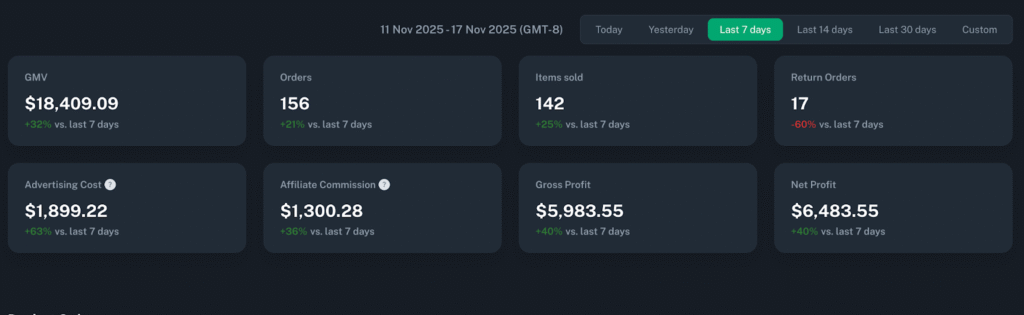
TikTok native analytics tool is robust for day-to-day insights, but third-party tools like Kixmon offer advanced features like real-time Profit Tracking for Tiktok Shop, GMV (Gross Merchandise Value), and even affiliate commission tracking. Kixmon seamlessly syncs with TikTok’s Seller Center and Ads Manager, providing more comprehensive insights into your e-commerce performance. You can also check best TikTok Shop Profit Trackers to get more accurate result from your TikTok Shop
Essential Metrics You MUST Track
To effectively measure TikTok ad performance, you need to understand and track several key metrics. Here are the metrics you should focus on:
Performance Metrics
Impressions & Reach
An impression is just how many times your ad is shown to someone, even if they don’t click on it. Reach, on the other hand, tells you how many different people have seen your ad. Both help you understand how many people are noticing your ad
Cost Per Mille (CPM)
CPM tells you how much you’re paying for every 1,000 impressions. It’s useful for assessing your ad spend efficiency and understanding how well your ad is performing relative to the cost.
Frequency
Frequency metric tracks how often a user sees your ad. High frequency can lead to ad fatigue, so monitoring this metric helps in avoiding overexposure. Ad frequency is widely used for brand awareness.
Engagement Metrics
Click-Through Rate (CTR)
Click Through Rate means the percentage of users clicked on AD. CTR is calculated by dividing the number of clicks by the number of impressions. A higher CTR indicates that your ad is compelling users to engage. If you CTR is low which is signal that your Creative or interest is not performing.
Video Views
Video Views are divided into 3-second, 6-second, and complete views. Monitoring video views at different time intervals helps gauge the interest level of users. The better the video views meant the better the creative is.
Engagement Rate
Engagement rate shows how many people interact with your ad by liking, commenting, or sharing it. This is important because it helps you see how much your audience cares about your content and how well it connects with them.
Conversion Metrics
Conversion Rate (CVR)
Conversion rate measures how many clicks resulted in a desired action, such as a purchase or sign-up. It’s crucial for understanding how effective your ad is in driving conversions.
Cost Per Acquisition (CPA)
CPA calculates how much it costs to acquire a new customer through your ad. It’s a vital metric for understanding whether your ads are profitable.
Cost Per Click (CPC)
CPC means cost per click which measures how much you pay for each click on your ad. CPC metric helps you assess the cost-efficiency of your campaign in driving traffic.
Business Impact Metrics
Return on Ad Spend (ROAS)
ROAS is a way to measure how much money you make from your ad campaign compared to how much you spend on it. It tells you if your ads are making a good profit. ROAS helps you see how much money you make for every dollar you spend on ads. A high ROAS means your ads are doing great and bringing in a lot of money compared to what you spent
Purchase Value
Purchase Value metric tracks the total value of purchases generated by your ad. It’s essential for understanding how much revenue your ads are driving.
Video Completion Rate
The video completion metric tells you how many people watched your ad all the way through. If a lot of people watch the whole video, it means your ad is interesting and holding their attention.
What is Attribution Analytics?
Attribution analytics is about figuring out how people go from seeing your ad to taking an action, like making a purchase. It helps you understand which parts of your marketing are most effective. It shows you which ads and actions helped the most in getting them to make that decision.
Core Features:
Assisted Conversions
Assisted Conversions tracks how other touchpoints in the customer journey contributed to a final conversion.
Performance Comparison
Compare different attribution windows to see how long it takes for users to convert after seeing an ad.
Time to Conversion
Conversion time shows how long it takes for people to act after seeing your ad, like buying something. Knowing this helps you figure out the best time to show your ads and fix any problems in the process to make your campaign work better.
TikTok Ads Analytics vs. Facebook & Google Ads
TikTok’s ad platform offers a unique approach with its algorithm-first, engagement-driven focus. Here’s a quick comparison of key metrics across TikTok, Facebook, and Google Ads:
| Metric | TikTok | Google Ads | |
| CPM | Generally lower | Generally higher | Varies |
| CTR | Higher for creatives | Generally lower | High for search ads |
| Conversion Tracking | Easy with Pixel | Advanced | Advanced |
TikTok’s unique approach favors engaging content that resonates with users over traditional targeting.
How to Analyze Your Ad Performance
Daily Performance Review Checklist
- Monitor key metrics like CPM, CTR, and ROAS daily.
- Identify trends and any significant changes in ad performance.
Identifying Top Performers
Look for winning creatives, as creativity is a crucial part of your campaign. The first impression users have of your ad comes through the creative, followed by the audience segments. Use split testing to refine your campaigns by testing different audiences
Split Testing with Analytics
Test different creatives, targeting options, and bidding strategies. Understand which combinations yield the best results.
Optimization Strategies Based on Analytics Data
Using data to optimize your campaigns is essential. Here are several strategies:
- Budget Reallocation: Move spend to high-ROAS ads.
- Audience Refinement: Use frequency and reach data to refine targeting.
- Creative Optimization: Focus on high engagement creatives.
- Bidding Strategy Adjustments: Switch between cost cap and lowest cost strategies depending on performance.
- Timing Optimization: Adjust your ad timings based on conversion data.
TikTok Analytics KPI Dashboard Setup
Building Your Dashboard
To track and visualize key performance indicators (KPIs) effectively, set up a dashboard using tools like Looker Studio or Coupler.io. Make sure to include essential KPIs such as ROAS, CTR, and conversion rates or you can use Kixmon Profit Tracker for TikTok Shop to have a pre-made dashboard with necessary metrics.
Common TikTok Analytics Mistakes to Avoid
To make the most of your TikTok ads and avoid common pitfalls, be mindful of these three mistakes:
Ignoring Early Learning Phase Data
During the early stages of your campaign, TikTok’s algorithm is still gathering data to optimize ad performance. Ignoring this phase and making changes too soon can disrupt this process. Give your campaign time to learn and adapt for optimal results.
Tip: Let the algorithm run for at least 3-7 days before making significant adjustments.
Over-Optimizing Too Quickly
Many advertisers tweak their campaigns based on short-term fluctuations, leading to over-optimization. Making too many changes too soon can prevent the algorithm from fully understanding the best way to reach your target audience.
Tip: Focus on long-term trends and make gradual, data-driven changes.
Neglecting Audience Insights
Failing to analyze audience behavior can result in missed opportunities for better targeting and engagement. TikTok provides valuable insights into user demographics, interests, and behaviors that can significantly improve ad performance.
Tip: Regularly review audience insights and refine your targeting based on data, not assumptions.
Conclusion
Mastering TikTok Ads Analytics is crucial for improving your campaign’s ROI. By tracking the right metrics and utilizing advanced tools like Kixmon TikTok Shop Profit Analytics give deeper insights into your performance and optimize your ads accordingly.

I’m Muhammad Ali, the founder of Kixmon LLC. I started Kixmon to make life easier for TikTok Shop sellers who struggle to track their real profits. With my experience in eCommerce and digital tools, I wanted to build a platform that clearly shows sellers how much they’re earning after all costs, fees, and commissions. My goal is simple: help sellers understand their numbers in real time so they can make smarter decisions and grow their business with confidence.