 START YOUR 7 DAY FREE TRIAL
TikTok Shop for Small Business
TikTok Shop has become a major force in e-commerce, helping small businesses grow faster than ever. It generated $14.7 billion in revenue for small businesses, showing its value as more than just a place for viral videos.
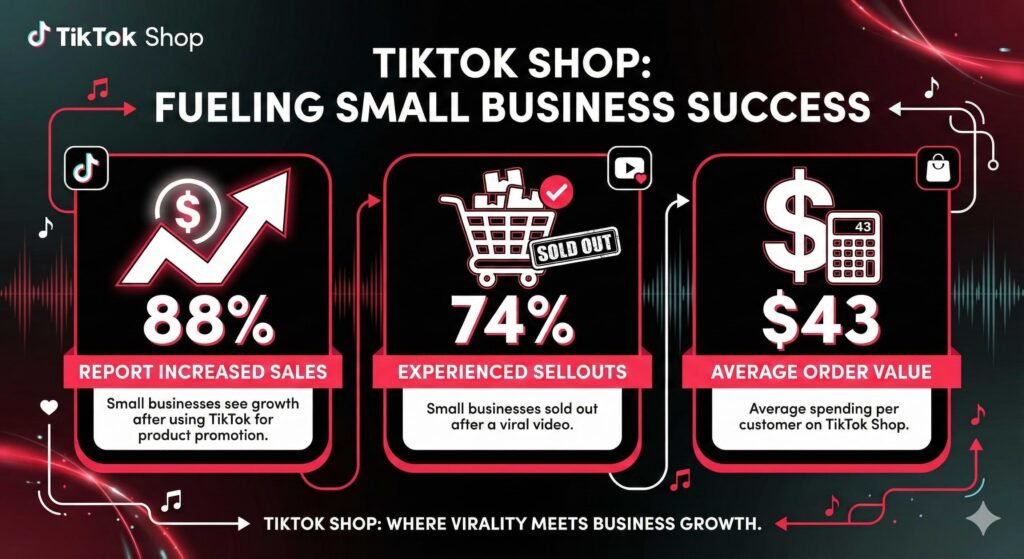
Adding TikTok to your sales strategy helps you connect with its community, interact with customers, and use viral trends to boost your results.
Why TikTok Shop for Small Businesses
TikTok Shop enables small businesses to access a broad audience through engaging and viral content. The platform offers no upfront costs and provides user-friendly sales tools, allowing businesses to leverage TikTok’s extensive community, increase visibility, and drive sales through trends and targeted advertising. This approach offers an affordable method for brand growth and direct customer engagement.
- 70% of TikTok users discover new brands and products on the platform.
- 3 out of 4 users are likely to make a purchase while browsing TikTok.
- 83% of users report that TikTok influences their purchase decisions.
Business Requirements for TikTok Shop
Before launching, ensure you meet the following TikTok Shop prerequisites:
Legal & Business Setup
- Business entity (sole proprietor, LLC, corporation, depending on region)
- Tax identification number (EIN in the US)
- Business bank account
- Registered business address
- Government-issued ID
TikTok Account Requirements
- TikTok creator account (can convert from personal)
- Account in good standing (no violations of community guidelines)
- Minimum 1,000 followers (for affiliate program participation)
- Regional eligibility (varies by country)
Product & Fulfillment Readiness
- Minimum inventory or dropshipping/print-on-demand setup
- Clear product photography and descriptions
- Chosen fulfillment method (self-shipping, third-party, or FBT)
Product Compliance Requirements
Before listing products, verify they meet TikTok Shop policies:
Prohibited Products:
- Adult content and sexual wellness items
- Alcohol, tobacco, and vaping products
- Weapons, ammunition, and tactical gear
- Counterfeit or replica goods
- Prescription medications and controlled substances
Restricted Categories (Require Certification):
- Beauty products (FDA registration for cosmetics)
- Electronics with lithium batteries (safety certifications)
- Children’s toys (CPSC compliance)
- Food and supplements (FDA/USDA approval)
- Jewelry with precious metals (authenticity documentation)
Policy violations can result in listing removal, account suspension, or permanent bans. Always review TikTok’s current prohibited items list before adding products.
TikTok Shop Fees & Costs
Many sellers find the fee structure surprising. TikTok does not charge a monthly subscription, but percentage-based fees can add up quickly if you do not keep track.
TikTok Fees Breakdown
1. Referral Fee: 6%
The referral fee represents the percentage TikTok deducts from each sale conducted on its platform. This fee compensates TikTok for connecting sellers with customers and facilitating transactions. TikTok collects this fee from the product’s sale price.
- For example, on a $50 sale, TikTok deducts $3.00 (6% of the sale price) as a referral fee.
- Exceptions to the Referral Fee:
- New Seller Incentive: New sellers on TikTok are eligible for a reduced referral fee of 1.8% to 2% for the first 60 to 90 days. This incentive is designed to encourage new businesses to join the platform.
- Category-Specific Fee Increases: Beginning in 2025, TikTok may raise the referral fee to 8% for specific product categories. This adjustment aligns the fee structure with product type and market demand.
- No Referral Fee on Returns: When a customer returns a product, TikTok does not apply a referral fee to the refunded amount.
Transaction/Processing Fee: 2.18-3.78%
TikTok charges a transaction fee for processing payments from buyers. This fee covers the costs of managing the payment system, ensuring transaction security, and verifying buyer information, similar to fees charged by other payment processors such as Stripe or PayPal.
- For example, on a $50 sale, the transaction fee ranges from $1.09 to $1.89, depending on factors such as payment method and region.
- Factors Affecting the Transaction Fee:
- Payment Method: Various payment options, including credit cards, debit cards, and digital wallets, may incur different processing fees.
- Region: The buyer’s location may affect the transaction fee because of regional variations in financial regulations and payment processing expenses.
- Payment Processor: The choice of payment processor can influence the transaction fee, as different processors maintain distinct pricing structures.
Fixed Per-Transaction Fee: $0.30
This is a flat fee that TikTok charges for each processed order, regardless of the number of items included. The fixed cost applies to every transaction and helps cover the basic expenses associated with order processing.
- For example, if a buyer purchases a $50 item, TikTok charges a $0.30 fee in addition to other applicable fees.
- Important Note: This fee is assessed per order, not per item. If a customer purchases multiple items in a single order, the fee remains $0.30, regardless of order size.
Fulfilled by TikTok (FBT) Fees
If a seller opts for TikTok’s Fulfilled by TikTok (FBT) service, TikTok stores, ships, and manages inventory on the seller’s behalf. While this service eliminates the need for sellers to handle storage, shipping, and returns, it incurs additional costs.
- Per-Unit Fee: TikTok charges a fee of $3.58 to $4.50 for each unit handled. The specific fee depends on factors such as product size and weight.
- Storage Fee: TikTok offers the first 30 days of storage at no cost. After this period, a monthly storage fee per unit applies to inventory remaining in the warehouse.
- Included Services:
- Return Handling: TikTok manages product returns from customers, including all associated logistics and processing.
- Damage/Loss Coverage: TikTok offers protection for products damaged or lost during storage or shipping, ensuring sellers are not financially liable for such incidents.
- For example, if a seller stores 100 units for 60 days, the base fulfillment fee totals $358, with additional storage fees applied for inventory stored beyond the initial 30 days.
Advertising Costs (if running Shop Ads)
TikTok provides optional advertising services for sellers seeking to promote products and increase visibility. These advertisements are intended to drive store traffic and sales, with costs determined by ad spend and targeting parameters.
- Campaign and Ad Group Minimums: TikTok Ads mandates a minimum daily budget of $50 for campaign-level ads and $20 for ad groups within campaigns. These minimums help ensure effective ad delivery and audience reach.
- Cost Per Click (CPC): TikTok ad CPC ranges from $0.30 to $3.00, depending on campaign targeting and market competitiveness. More specific audience targeting typically results in higher CPC.
- Return on Ad Spend (ROAS): A well-optimized campaign can achieve a ROAS of 2:1 to 4:1, meaning each dollar spent on ads generates $2 to $4 in sales. This metric reflects the effectiveness of ad campaigns in generating revenue relative to advertising expenditure.
Discovery Without Massive Marketing Budgets
Unlike other e-commerce platforms that rely on paid ads for visibility, TikTok Shop helps people find your products naturally. This means small businesses can compete without spending a lot on ads. TikTok’s algorithm focuses on engagement and content quality, so you can reach new customers even without big influencer campaigns or a huge following.
Products That Sell Well on TikTok Shop
While TikTok Shop supports a wide range of products, those that resonate visually and emotionally with the platform’s audience tend to perform best:
- Visually appealing products (beauty, fashion, home goods, tech accessories)
- Products priced between $15 and $75 often sell quickly because they encourage impulse buys. Items that solve everyday problems or show clear before-and-after results work well, especially in tutorials and demonstrations.
Selling with Live Shopping and Affiliate Marketing
Live Shopping: Engage and Convert
TikTok Live Shopping can deliver conversion rates up to six times higher than traditional e-commerce. Use it to build trust and create urgency. Offer special live-stream deals, show behind-the-scenes product creation, and talk directly with your audience to build strong relationships. You can stream from your phone or computer, and using software like OBS can improve your video quality.
Creator Affiliate Program: Scalable Growth
TikTok’s Creator Affiliate Program enables small businesses to scale by partnering with creators. Commissions are paid only when a creator generates a sale, reducing upfront costs. To maximize this program:
- Work with micro-influencers (10K-100K followers) who offer high engagement without the hefty price tag.
- Encourage user-generated content (UGC), since authentic posts often lead to more sales.
TikTok’s content algorithm rewards creativity, engagement, and authenticity. Key elements of a high-converting TikTok video include:
- Strong Hooks: Capture attention within the first 3 seconds.
- Engaging Storytelling: Focus on problem-solving and before/after transformations.
- Use of Trending Sounds: Leverage popular audio to amplify your reach.
- Clear Call-to-Action: Direct viewers to your shop or to specific products.
Make your videos real and genuine instead of overly polished. TikTok users care more about authenticity than perfection.
On TikTok, good content matters more for sales than the product itself. The algorithm values content quality, watch time, engagement, and shares over follower count. This means someone with 500 followers and great videos can do better than someone with 50,000 followers but less interesting content.
The Psychology of TikTok Content
The majority of TikTok users scroll rapidly, typically spending only 5 to 15 seconds on each video before deciding whether to continue watching. Consequently, content creators have approximately three seconds to capture viewers’ attention and encourage them to stop scrolling. Success depends on making the initial moments of a video sufficiently engaging to attract viewers. Failure to immediately capture interest often results in viewers skipping the content.
A key insight is that the first three seconds of a video are critical. If the content does not immediately engage the viewer, it is likely to be skipped.
TikTok’s discovery algorithm prioritizes engagement metrics rather than follower count. Videos are distributed to viewers based on their demonstrated interests. Increased engagement, such as likes, comments, shares, and longer watch times, results in broader distribution of the video. This mechanism enables content to reach a larger audience regardless of the creator’s existing follower base.
- New video gets 200-500 random viewers.
- Watch time % determines the next distribution.
- Engagement (likes, comments, shares) amplifies reach.
- The algorithm learns viewer preferences and distributes accordingly.
Implication: If your video gets over 60% watch time, like 30 seconds on a 50-second video, it can reach more than 50,000 viewers—even if you only have 1,000 followers. Branded content typically performs worse than authentic, behind-the-scenes content. TikTok users prefer genuine, relatable material.
The High-Converting Content Framework
Every successful TikTok Shop product video follows this pattern:
The Hook (0-3 seconds), while your primary goal is to stop viewers from scrolling. In order to stop scrolling you can use following Methods that works.
- Problem hook: “I used this for 30 days and…”
- Curiosity hook: “POV: You finally found the solution to…”
- Visual hook: Satisfying product demonstration or transformation
- Question hook: “Has this ever happened to you?”
- Controversy/bold statement: “This $X item changed everything.”
Using Kixmon for Advanced Analytics
While TikTok’s native analytics show user activity, tracking actual profits requires more advanced tools. Tools like Kixmon.com provide deeper insights, helping you monitor real-time profits, product performance, and track all relevant fees for a clear view of your store’s profitability.
Kixmon Integration Benefits:
- 45+ fee tracking: Automatically captures all TikTok fees, affiliate commissions, ad spend
- Real-time TikTok profit Tracker: See actual net profit, not just revenue
- Product-level profitability: Identify which products are truly profitable
- Creator ROI: Track profit per affiliate creator
- Seasonal trends: Identify high-profit periods
- Profit leaks: Automatically flag unexpected cost increases
Optimization Tips for Success
Content Analytics:
Consistently monitor performance metrics such as engagement and conversion rates. This approach helps identify effective strategies and scale successful content.
Influencer Partnerships:
Work with micro-influencers who fit your brand. They often give you better results and more authentic promotion. Social Proof: Show user reviews and feedback. Customer experiences can make your business more trustworthy to TikTok users.
Conclusion
TikTok Shop gives small businesses a chance to use viral trends, reach more customers, and grow sales without a big upfront investment. By working with creators, making great content, and using live shopping, you can build a strong and scalable business.
Frequently Asked Questions
How much does it cost to sell on TikTok Shop?
No Tiktok does not have monthly subscription. Main costs are transaction fees:
6% referral fee
2-4% transaction processing fee
$0.30 per order fixed fee
Fulfillment fees if using FBT ($3.58+)
Total platform cost: 8-10% of the sale price (before ads/shipping)
Do I need a business license to sell on TikTok Shop?
Depends on your location and business structure. Most regions require:
Sole proprietor: Registration in your state
LLC/Corporation: Official formation documents
Tax ID (EIN in the US)
Check your local requirements.
How long does seller approval take?
Typically 2-3 business days after verification submission. Can be as fast as same-day or take up to 2 weeks if documents need review.
What regions can access TikTok Shop?
Currently available in the US, UK, Canada, Australia, and expanding. Check official TikTok Shop documentation for current availability in your region.

I’m Muhammad Ali, the founder of Kixmon LLC. I started Kixmon to make life easier for TikTok Shop sellers who struggle to track their real profits. With my experience in eCommerce and digital tools, I wanted to build a platform that clearly shows sellers how much they’re earning after all costs, fees, and commissions. My goal is simple: help sellers understand their numbers in real time so they can make smarter decisions and grow their business with confidence.