 START YOUR 7 DAY FREE TRIAL
TikTok Ad Costs

The problem isn’t finding cheap impressions. At roughly $4 per 1,000, TikTok impressions are already cheap. The problem is knowing how much of each order survives product cost, shipping, TikTok Shop fees, affiliate commissions and refunds, because that leftover is the most you can pay for a sale. Using a TikTok ad cost calculator can also make it easier to estimate spend, compare campaign scenarios, and plan more accurately before launching.
How much do TikTok ads cost?
TikTok ads cost about $4 to $9 per 1,000 impressions and $0.50 to $1.00 per click in 2026, with a median cost per purchase of $17.07 for ecommerce brands. You can’t launch an Ads Manager campaign below $50 a day per campaign or $20 a day per ad group. Your own numbers will shift with industry, country, creative and season.
|
Metric |
2026 benchmark |
Source and data period |
|---|---|---|
|
CPM (cost per 1,000 impressions) |
$4.08 median (ecommerce); $9.16 average (managed US campaigns) |
Triple Whale, Aug 2025 to Jul 2026; WebFX via Uproas, 2024 to 2025 data |
|
CPC (cost per click) |
$1.00 average; $0.25 to $4.00 range |
WebFX via Uproas |
|
CTR (click-through rate) |
0.61% median |
Triple Whale |
|
CVR (conversion rate) |
1.56% median |
Triple Whale |
|
CPA (cost per purchase) |
$17.07 median |
Triple Whale |
|
ROAS (platform-reported) |
1.51 median |
Triple Whale |
|
AOV (average order value) |
$50.32 median |
Triple Whale |
|
Minimum daily budget, Ads Manager |
Over $50 per campaign; over $20 per ad group |
TikTok Ads Manager help center |
|
Minimum daily budget, Promote |
About $3 |
Sprout Social |
The year-over-year shift matters more than any single number. In Triple Whale’s data, median CPM fell from $5.71 to $4.08 and CPA fell from $24.86 to $17.07. Conversion rate also fell, from 2.46% to 1.56%. Reach got cheaper. Each click got less likely to buy.
TikTok CPM in 2026: what a good CPM looks like
A good TikTok CPM in 2026 is under $5 for ecommerce conversion campaigns and under about $9 for broader managed campaigns. Triple Whale puts the ecommerce median at $4.08 and Lebesgue’s 2026 ecommerce data puts it at $4.80. If you’re paying $12 or more outside Q4, check your creative and targeting before you blame the auction.
TikTok CPM is unusually flat across industries. In Triple Whale’s dataset, the gap between the cheapest and most expensive category is only $1.15.
|
Industry |
Median CPM |
Median CTR |
|---|---|---|
|
Sports & Outdoors |
$3.46 |
0.54% |
|
Health & Wellness |
$3.67 |
0.51% |
|
Beauty |
$3.92 |
0.51% |
|
Lifestyle & Boutique |
$4.01 |
0.61% |
|
Apparel & Accessories |
$4.16 |
0.74% |
|
Toys, Art & Collectibles |
$4.40 |
0.55% |
|
Electronics |
$4.40 |
0.64% |
|
Food & Beverage |
$4.54 |
0.45% |
|
Pets & Animals |
$4.59 |
0.41% |
|
Home & Garden |
$4.61 |
0.59% |
Source: Triple Whale TikTok benchmarks, 5,900+ brands, Aug 1, 2025 to Jul 31, 2026. Lebesgue figure from Lebesgue’s TikTok benchmarks.
Two caveats before you use these numbers. First, they’re medians from ecommerce brands that use Triple Whale. Finance, insurance and legal advertisers usually pay more. Second, CPM varies by country, and we haven’t found a 2026 by-country CPM dataset with a published method. [DATA NEEDED: anonymized median CPM by market from Kixmon’s 15 supported markets]
TikTok CPC in 2026
TikTok’s average cost per click is about $1.00 in 2026, inside a $0.25 to $4.00 range in WebFX’s data. Ecommerce accounts with median CPM and CTR land closer to $0.67. CPC isn’t a separate price you negotiate. It falls out of two numbers you already see in Ads Manager: CPM and click-through rate.
That’s why creative moves CPC more than bidding does. A hook that doubles CTR halves your cost per click without touching the bid.
One warning: don’t chain benchmark medians to predict CPA. Multiplying median CPM, CTR and CVR gives about $43 per purchase, while the measured median CPA is $17.07. Medians from different accounts don’t multiply cleanly. Use them as guardrails and use your own account data for forecasts.
TikTok CPA and ROAS by industry
Most ecommerce categories acquire a TikTok customer for $10 to $29 in 2026, but platform-reported ROAS ranges from 2.70 in Apparel to below 0.50 in Beauty, Food & Beverage and Health & Wellness. Low CPA doesn’t guarantee profit when order values are small. The last column shows how much of a typical order the ad cost absorbs.
|
Industry |
Median CPA |
Median CVR |
Median ROAS |
Median AOV |
CPA as % of AOV |
|---|---|---|---|---|---|
|
Apparel & Accessories |
$20.64 |
2.08% |
2.70 |
$73.79 |
28% |
|
Home & Garden |
$19.33 |
1.61% |
2.02 |
$61.28 |
32% |
|
Lifestyle & Boutique |
$19.59 |
2.06% |
2.00 |
$53.77 |
36% |
|
Electronics |
$28.90 |
1.46% |
1.98 |
$70.72 |
41% |
|
Toys, Art & Collectibles |
$18.37 |
1.71% |
1.57 |
$47.43 |
39% |
|
Sports & Outdoors |
$14.67 |
0.99% |
1.44 |
$51.96 |
28% |
|
Beauty |
$10.32 |
1.12% |
0.46 |
$29.35 |
35% |
|
Health & Wellness |
$11.17 |
0.80% |
0.42 |
$18.56 |
60% |
|
Food & Beverage |
$12.44 |
0.99% |
0.33 |
$30.19 |
41% |
Source: Triple Whale, Aug 2025 to Jul 2026. The last column is our calculation from Triple Whale’s medians, so read it as a rough ratio, not a measured figure. We left out Pets & Animals because its reported $0.38 AOV looks like a data error.
Beauty and skincare advertisers: a $10.32 CPA looks cheap until you set it against a $29.35 order. That’s 35% of revenue gone to ads before product cost, fees or creator commission. Triple Whale also notes that last-click tracking may undercount TikTok’s delayed purchases in Beauty, so check blended revenue before you cut spend.
TikTok ad pricing models and bidding options
TikTok sells ads through an auction, and the billing event follows your campaign goal: impressions for reach (CPM), impressions optimized toward an action for conversions (oCPM), clicks for traffic (CPC) and qualified video views for view campaigns (CPV). Most direct-response advertisers end up on oCPM, because it bids harder for people likely to buy.
|
Pricing model |
You pay for |
Best for |
Watch out for |
|---|---|---|---|
|
CPM |
1,000 impressions |
Reach and awareness |
Cheap views that never click |
|
oCPM |
Impressions, optimized to a conversion event |
Purchases, sign-ups, installs |
Needs clean pixel or Events API data and about 50 conversions per ad group to stabilize |
|
CPC |
Clicks to your destination |
Traffic campaigns |
Clicks from low-intent viewers |
|
CPV |
Video views past a view threshold |
Video view campaigns |
Views that don’t lead to profile visits or clicks |
On top of the pricing model, you choose how hard TikTok bids:
- Maximum delivery (lowest cost) spends your full budget to get the most results. Start here until you know your profitable CPA.
- Cost cap targets an average cost per result. Set it at or slightly above your break-even CPA, not below it, or delivery stalls.
- Bid cap limits what TikTok bids in any single auction. It gives the most control and needs daily monitoring.
- GMV Max ROI target applies to TikTok Shop campaigns. TikTok optimizes toward a gross revenue to spend ratio, so set the target from your break-even ROAS (see the profit math below), not from a guess.
TikTok ads minimum budget in 2026
TikTok Ads Manager requires a daily budget above $50 at campaign level and above $20 at ad group level, per TikTok’s help center. A lifetime ad group budget must cover $20 for every scheduled day, so a 31-day ad group needs at least $620. These floors only get a campaign approved. Exiting the learning phase usually takes far more.
Ads Manager rules that trip people up
- Lifetime budgets also need more than $50 at campaign level. At ad group level, the minimum is $20 × total scheduled days, including days already passed.
- Budget type is locked. You can raise or lower the amount after launch, but you can’t switch between daily and lifetime.
- Campaign budget below ad group budget causes delivery problems. TikTok’s help center warns against it.
Key Factors That Affect Your TikTok Ad Costs
Creative Quality
Creative quality is one of the single most impactful levers within your control. Native, TikTok-first videos shot vertically, featuring real people, using platform-appropriate hooks, and leaning into trends consistently outperform generic or repurposed ads. The first three seconds are critical: clear value propositions, strong visual hooks, or intriguing questions help keep viewers from scrolling away. Using on-screen captions is especially important because a significant share of users watch with sound off, and captioned videos tend to achieve higher completion and engagement rates.
For example, a top-performing TikTok ad for a skincare brand might show a creator applying the product, quickly describe their problem, and show a visible before-and-after result in under 15 seconds. The video opens with a close-up, uses a catchy trending sound, and overlays bold text such as “Watch my skin clear in one week.” Quick pacing and authentic reactions, such as surprised expressions or genuine testimonials, help grab attention and build trust. This style of content often generates higher engagement rates, stronger completion rates, and lower CPMs than overly polished or generic ads.
Audience Strategy (Broad vs Narrow)
Broad targeting, which taps into larger user pools, can help keep CPMs lower because there is more inventory and less concentrated auction competition. However, very broad audiences may reduce relevance if your creative and offer do not clearly speak to the right people, which can raise CPC or CPA even if CPM remains attractive. Narrow targeting, which targets specific demographics, interests, or behaviors, usually increases CPMs as competition intensifies within smaller audiences. Still, gains in relevance can improve click‑through and conversion rates enough to reduce overall CPA. Custom audiences built from website visitors, email lists, or app users often cost more per impression because multiple advertisers chase the same high‑intent users. Still, their higher intent can justify the premium.
Bidding Strategy (Automated vs Manual)
Automated bidding options, such as “lowest cost,” typically deliver strong efficiency for many advertisers by leveraging real‑time auction data to adjust bids automatically. Cost‑cap strategies let you specify an acceptable CPA or CPC to protect margins, though caps that are too strict can limit delivery and scale. Bid‑cap strategies provide the greatest control but usually require close monitoring and more advanced account management to avoid hurting efficiency.
For advanced bid management, experienced marketers may benefit from layering automated and manual bidding across campaign groups. For example, start with automated bidding to establish performance benchmarks, then introduce bid caps on high-performing ad sets to maximize efficiency in stable segments, while running cost caps on newer or exploratory ad groups. Temporarily raise bid caps during peak competition periods (such as Q4 shopping events) to maintain delivery, then dial them back afterward. Monitoring auction insights and pacing reports can help you proactively fine-tune bids and ensure your budget delivers consistent results, especially when optimizing for high-value conversion events.
Seasonal Trends
Seasonality plays a major role in TikTok ad costs. Q1 (January–March) often offers some of the lowest CPMs of the year as many brands pull back after the holidays. Q4 (October–December) typically sees the highest CPMs as retailers and other advertisers compete aggressively for Black Friday, Cyber Monday, and holiday shoppers. Within weeks and days, costs can also shift due to competition and user behavior, so it is best to rely on your own performance data rather than fixed assumptions about weekday or time‑of‑day premiums.
Strategies to Reduce TikTok Ad Costs
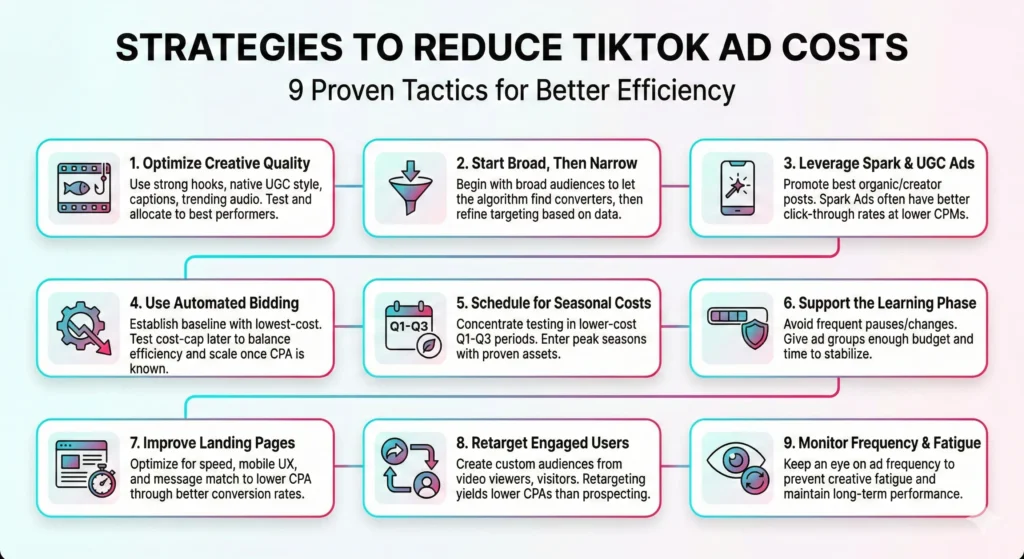
1. Optimize Creative Quality for Lower CPMs
Use strong hooks in the first three seconds, adopt native UGC style, add captions, and experiment with trending audio. Test multiple creative variations to identify winners, then allocate budget toward the best performers.
2. Start Broad Before Over‑Narrowing
Begin with broader audiences or automatic targeting to let the algorithm find pockets of performance, then refine targeting once you have data on who converts. Avoid stacking too many restrictions too early, which can spike CPMs and throttle scale.
3. Leverage Spark and UGC Ads
Promote your best organic or creator‑generated posts rather than building only “polished” ad assets. Spark Ads that carry existing engagement often produce better click‑through and conversion metrics at similar or lower CPMs.
4. Use Automated Bidding as Your Default
Start with the lowest-cost bidding to establish a baseline performance and gather enough data. Once you know your profitable CPA range, test cost‑cap bidding to balance efficiency and scale.
5. Schedule Campaigns Around Seasonal Costs
Concentrate testing and scaling efforts in lower‑cost periods such as Q1–Q3 when possible, then enter Q4 with already‑proven creative and audiences if peak shopping season is critical for your business.
6. Support the Learning Phase
Avoid pausing and restarting campaigns too frequently and limit abrupt budget changes. Give ad groups enough budget and time to reach a meaningful conversion volume, which helps the system stabilize and prevents cost spikes from repeated learning resets.
7. Improve Landing Pages to Reduce CPA
Optimize landing pages for fast load times, message match with the ad, and mobile‑first UX. Even modest conversion‑rate improvements translate directly into lower effective CPA without requiring cheaper traffic.
8. Retarget Engaged Users
Build custom audiences from high‑intent signals such as video viewers, profile visitors, site visitors, and past purchasers. Retargeting and lookalikes from these groups usually deliver significantly lower CPAs than cold prospecting alone.
9. Monitor Frequency and Prevent Creative Fatigue
Monitor ad frequency and performance indicators such as CTR and conversion rate. When performance begins to decline at higher frequencies, rotate in new creatives or audiences to maintain engagement and avoid rising costs due to fatigue.
Strategic Budget Allocation for Maximum ROI
Effective budget allocation evolves as campaigns move from testing to optimization to scaling.
- In the testing phase (for example, month one), many brands allocate a smaller share of their total budget to exploring audiences and creatives while ensuring each ad group has enough daily spend for meaningful insights.
- In the optimization phase (months two to three), a larger share of the budget shifts toward the best‑performing combinations, with a smaller portion reserved for ongoing tests.
- In the scaling phase (month four and beyond), most of the budget goes to proven winners, while a disciplined testing stream continues to feed new creatives and audiences to prevent performance from stagnating.
How much should you spend on TikTok ads per month?
Plan on about $2,000 to $3,500 a month to test TikTok ads properly, and $600 a month only if you accept that one $20-a-day ad group probably won’t exit learning. The right number comes from your target CPA, not from the platform floor. Here’s how five common setups price out over a month.
|
Setup |
Daily spend |
Days |
Total |
|---|---|---|---|
|
Promote test on one video |
$3 to $10 |
7 |
$21 to $70 |
|
One ad group at the platform floor |
$20 |
30 |
$600 |
|
Creative test: 3 ad groups at $50 each |
$150 |
14 |
$2,100 |
|
One ad group budgeted to exit learning at a $15 CPA |
$107 |
30 |
$3,210 |
|
Scaling: 3 learning-ready ad groups at a $15 CPA |
$321 |
30 |
$9,630 |
These are arithmetic scenarios, not forecasts. Swap in your own target CPA and the learning-phase formula above gives your number.
A useful split once you have data: put most of the budget behind proven ad groups and keep a fixed slice, say 20%, for new creative tests. Without that test budget, your winners fatigue and CPM creeps up with nothing ready to replace them.
TikTok ad costs by format
In-Feed ads, Spark Ads and GMV Max all run through the same auction, so they share the CPM ranges above; the differences show up in CTR, conversion rate and what you can measure. Reserved formats such as TopView are sold by TikTok’s sales team at quoted prices, not through the self-serve auction.
|
Format |
How it’s bought |
What it costs in practice |
Best for |
|---|---|---|---|
|
In-Feed ads |
Auction in Ads Manager |
Platform benchmarks above ($4 to $9 CPM) |
Prospecting and testing new creative |
|
Spark Ads |
Auction, using an existing organic or creator post |
Higher CPM, higher CTR in one 2026 compilation |
Scaling posts that already earn engagement |
|
Product GMV Max |
Automated auction tied to your TikTok Shop catalog |
Set by your ROI target and budget |
TikTok Shop sellers driving catalog sales |
|
LIVE GMV Max |
Automated auction promoting a livestream |
Set by your ROI target and budget |
Sellers with a regular LIVE schedule |
|
Promote |
In-app boost |
From about $3 a day |
Quick tests on single videos |
|
TopView and other reserved formats |
Direct buy through TikTok sales |
Custom quote, not published |
Launches and brand moments |
Spark Ads: in Digital Applied’s 2026 compilation, Spark Ads averaged a 2.4% CTR on an $11.85 CPM, against 1.0% CTR on a $9.16 CPM for standard In-Feed ads (via Pace Ads). Run the CPC formula and Spark works out near $0.49 a click versus $0.92. Pace Ads also flags that the same source lists a $1.41 Spark CPC, so treat the exact figure loosely. The direction is consistent: you pay more per impression and less per click.
GMV Max: Product GMV Max counts GMV from same-day orders with a one-day attribution window . That GMV is gross revenue. It ignores product cost, fees, affiliate commission and refunds, which is exactly where TikTok Shop sellers lose track of profit.
Are TikTok ads cheaper than Facebook and Google ads?
Yes on reach, not always on results. Triple Whale’s 2026 data puts TikTok’s ecommerce median CPM at $4.08 against $15.06 for Meta, roughly a quarter of the price. But TikTok’s 0.61% median CTR and 1.51 median ROAS mean cheaper impressions don’t automatically become cheaper customers. Compare platforms on cost per profitable order.
|
Platform |
2026 CPM reference |
Where it wins |
Where it’s weaker |
|---|---|---|---|
|
TikTok |
$4.08 median (Triple Whale); $4.80 (Lebesgue) |
Cheap cold reach, product discovery, creator-led video, in-app checkout through TikTok Shop |
Lower CTR, short attribution windows, needs a steady supply of new creative |
|
Meta (Facebook, Instagram) |
$15.06 median (Triple Whale); $6.96 to $12.46 by industry (Lebesgue) |
Retargeting depth, older audiences, mature conversion data |
Higher reach cost in most ecommerce categories |
|
|
Mostly bought per click on Search and Shopping |
Captures people already searching for your product |
Little demand creation; costs follow keyword competition |
In practice, most sellers use TikTok to create demand and Meta or Google to catch it. If you measure TikTok only on last-click ROAS, you’ll undervalue it. If you measure it only on CPM, you’ll overvalue it.
What makes TikTok ads cost more or less
Seven factors set most of your TikTok ad cost: creative quality, audience size, bid strategy, season, country, conversion tracking and how often you change live campaigns. Creative has the largest effect you control, because TikTok’s auction rewards ads people watch and engage with by serving them more cheaply.
|
Factor |
Pushes cost up |
Pulls cost down |
|---|---|---|
|
Creative |
Polished, ad-looking video; slow first 3 seconds; no captions |
Native, creator-style video; a clear hook in the first 3 seconds; on-screen text for sound-off viewers |
|
Audience |
Narrow interest stacks and small custom audiences |
Broad or automatic targeting while the ad group learns |
|
Bid strategy |
Cost caps or bid caps set below what the market clears |
Maximum delivery until you know your real CPA |
|
Season |
Q4 retail weeks: Black Friday falls on November 27, 2026 and Cyber Monday on November 30, 2026 |
January to March, when many advertisers pull back |
|
Country |
Mature ad markets with heavy competition |
Markets with fewer advertisers bidding |
|
Tracking |
Missing pixel or Events API events, so TikTok optimizes on partial data |
Server-side events and a high match rate |
|
Account changes |
Frequent edits and large budget jumps that restart learning |
Steady budgets, changed in small steps |
Example of a strong hook: a creator holds up a phone in its case, says “this survived a 2-meter drop,” drops it, and shows the result in under 10 seconds. The product, the claim and the proof all land before a thumb can scroll.
Why a low CPM doesn’t mean a profitable TikTok campaign
A TikTok campaign is profitable only when its cost per order stays below what each order leaves after product cost, shipping, TikTok Shop fees, affiliate commission and refunds. That leftover is your break-even CPA. Most sellers never calculate it, so they judge campaigns on ROAS and scale ads that lose money on every sale.
Worked example: one $30 TikTok Shop order
The inputs below are illustrative. TikTok Shop fee rates differ by market and category, so pull your real rate from Seller Center.
|
Line item |
Amount |
|---|---|
|
Sale price |
$30.00 |
|
Product cost (COGS) |
−$8.00 |
|
Shipping and packaging |
−$5.00 |
|
TikTok Shop fees (8% assumed) |
−$2.40 |
|
Affiliate commission (15%) |
−$4.50 |
|
Refund allowance (5% of revenue) |
−$1.50 |
|
Left to pay for ads (break-even CPA) |
$8.60 |
Now look at what common ROAS figures mean for this order:
- ROAS 4.0: ads cost $7.50 per order. You keep $1.10.
- ROAS 2.0: ads cost $15.00 per order. You lose $6.40, while Ads Manager shows a campaign that “doubles your money.”
- ROAS 1.51 (the 2026 TikTok median): ads cost $19.87 per order. You lose $11.27.
The ad platform isn’t lying. It reports gross revenue, because that’s all it can see.
The gap no single TikTok screen closes
TikTok spreads the data you need across four places. Ads Manager has spend and GMV. Seller Center has orders, fees and refunds. Affiliate commissions sit in the affiliate tools. Product cost lives in your own spreadsheet. None of them joins those numbers per order.
That’s the gap Kixmon is built for.
How Kixmon tracks true TikTok ad cost and profit
See net profit per order, product and SKU. Kixmon syncs TikTok Shop orders, fees and refunds with your product costs, so every order shows what it actually earned.
Count every ad cost, not just spend. Kixmon pulls TikTok Ads Manager costs, including GMV Max spend, ad credits and coupons, and assigns them to the orders they drove.
Split affiliate commissions by type. In the example above, creator commission costs nearly twice as much as TikTok’s own fees. Kixmon breaks them out so you can see which affiliate deals pay off.
Find your break-even CPA and ROAS per product. Set GMV Max ROI targets and cost caps from real margins instead of guesses, and scale only the campaigns that make contribution profit.
Pricing: [DATA NEEDED: Kixmon plan names, monthly prices and order or store limits, with the date checked]
Where Kixmon isn’t the right fit: Kixmon reports profit; it doesn’t buy media, set bids or edit campaigns. It doesn’t reconcile TikTok Shop payouts. It’s built around TikTok Shop data, so if you send TikTok ad traffic only to your own website store, [DATA NEEDED: confirm whether Kixmon supports website-only TikTok advertisers].
Kixmon supports TikTok Shop sellers and advertisers in 15 markets: the United States, United Kingdom, Ireland, Germany, France, Italy, Spain, Japan, Brazil, Mexico, Singapore, Malaysia, the Philippines, Thailand and Vietnam.
How to lower your TikTok ad costs
The fastest way to cut TikTok ad costs is to raise CTR with better hooks, then protect the learning phase so TikTok can find buyers at a stable price. Targeting tweaks and bid changes help less than most advertisers expect. Work through these in order.
- Fix the first 3 seconds. Test 3 to 5 hooks per product. A move from 0.6% to 1.0% CTR cuts CPC by 40% at the same CPM.
- Start broad. Let automatic or wide targeting find buyers before you add interest layers. Narrow stacks raise CPM.
- Spark your best organic posts. Posts that already earn comments and shares often click through at higher rates than new ad-only creative.
- Fund one ad group properly instead of five thinly. Use the learning-phase formula: target CPA × 50 ÷ 7 per day.
- Change budgets in small steps. Large jumps and frequent edits restart learning and spike costs for days.
- Send complete conversion data. Run the TikTok pixel and the Events API together so oCPM optimizes on real purchases.
- Set caps from margin, not from hope. Use your break-even CPA for cost caps and your break-even ROAS for GMV Max ROI targets.
- Retarget engaged viewers. Video viewers, profile visitors and past buyers usually convert at a lower CPA than cold audiences.
- Rotate creative before it fatigues. When frequency rises and CTR drops for several days in a row, launch replacements.
- Test early in the year, scale proven winners in Q4. Use January to March to find winning creative while auctions are quieter.
Questions to answer before you scale TikTok spend
Scale a TikTok campaign only when you can answer these five questions with a number. If you can’t, more budget usually means losing money faster.
- ☐ What is my break-even CPA for this product after COGS, shipping, TikTok Shop fees, affiliate commission and refunds?
- ☐ Has this ad group passed about 50 conversions, or is it still learning?
- ☐ Is my cost cap or GMV Max ROI target set from that break-even number?
- ☐ Which of my top three SKUs makes money after ads, and which only makes GMV?
- ☐ Do I have at least two new creatives ready for when the current winner fatigues?
Frequently asked questions
How much do TikTok ads cost?
TikTok ads cost about $4 to $9 per 1,000 impressions and roughly $0.50 to $1.00 per click in 2026. Ecommerce brands pay a median $17.07 per purchase, per Triple Whale. Your price depends on industry, country, season and, above all, creative.
What is a good CPM for TikTok ads?
Under $5 is good for ecommerce conversion campaigns in 2026, and under about $9 is in line with broader benchmarks. A CPM above $12 outside Q4 usually points to weak creative or over-narrow targeting.
What is the minimum budget for TikTok ads in 2026?
TikTok Ads Manager needs a daily budget above $50 per campaign and above $20 per ad group. A lifetime ad group budget must cover $20 per scheduled day, so 31 days needs $620. In-app Promote starts at about $3 a day.
What is the TikTok ads minimum budget in Brazil?
TikTok’s Portuguese help center lists the same floor in US dollars: above US$50 per campaign and US$20 per ad group. Local guides quote reais figures from R$50 to R$100, so check the floor Ads Manager shows in your billing currency before you plan.
How much do 1,000 views cost on TikTok ads?
If you mean 1,000 impressions, that’s your CPM: about $4 to $9 in 2026. Paid views counted past a watch threshold cost more than raw impressions, because fewer people watch that long. Check the CPV column in Ads Manager for your own campaigns.
How much should I spend on TikTok ads per month?
About $2,000 to $3,500 a month gives one product a fair test. That covers either three ad groups at $50 a day for two weeks or one ad group funded to exit learning at a $15 CPA. $600 a month at the $20 floor rarely produces enough conversions to learn from.
Are TikTok ads cheaper than Facebook ads?
Per impression, yes: $4.08 median CPM on TikTok versus $15.06 on Meta in Triple Whale’s 2026 data. Per profitable customer, it depends on your product, because TikTok’s CTR and conversion rates also run lower.
How much does it cost to promote a video on TikTok?
TikTok Promote starts at about $3 a day, runs for 1 to 7 days and caps around $1,000 a day. It’s useful for testing a video. For conversion campaigns with bidding and reporting, use Ads Manager.
How much do TikTok Shop ads cost?
TikTok Shop ads now run as GMV Max, where you set a budget and an ROI target instead of a bid. Set that target at or above your break-even ROAS, because GMV Max reports gross revenue, not profit.
Which countries does Kixmon support for TikTok ad cost tracking?
Kixmon supports 15 markets: the United States, United Kingdom, Ireland, Germany, France, Italy, Spain, Japan, Brazil, Mexico, Singapore, Malaysia, the Philippines, Thailand and Vietnam. It syncs ad and order data in each one and reports profit in the same view.
The bottom line on TikTok ad costs
TikTok is still one of the cheapest places to buy attention in 2026, at about $4 per 1,000 ecommerce impressions. The trade-off is lower click-through and conversion rates, plus a platform that reports gross revenue, not profit.

I’m Muhammad Ali, the founder of Kixmon LLC. I started Kixmon to make life easier for TikTok Shop sellers who struggle to track their real profits. With my experience in eCommerce and digital tools, I wanted to build a platform that clearly shows sellers how much they’re earning after all costs, fees, and commissions. My goal is simple: help sellers understand their numbers in real time so they can make smarter decisions and grow their business with confidence.